
Dubai New Year's Eve 2026: The Explosive Logistics Network That Made 48 Shows Possible
Category
Publish Date
Read Time
The Journey Behind the Event
2026-01-01
15 minutes
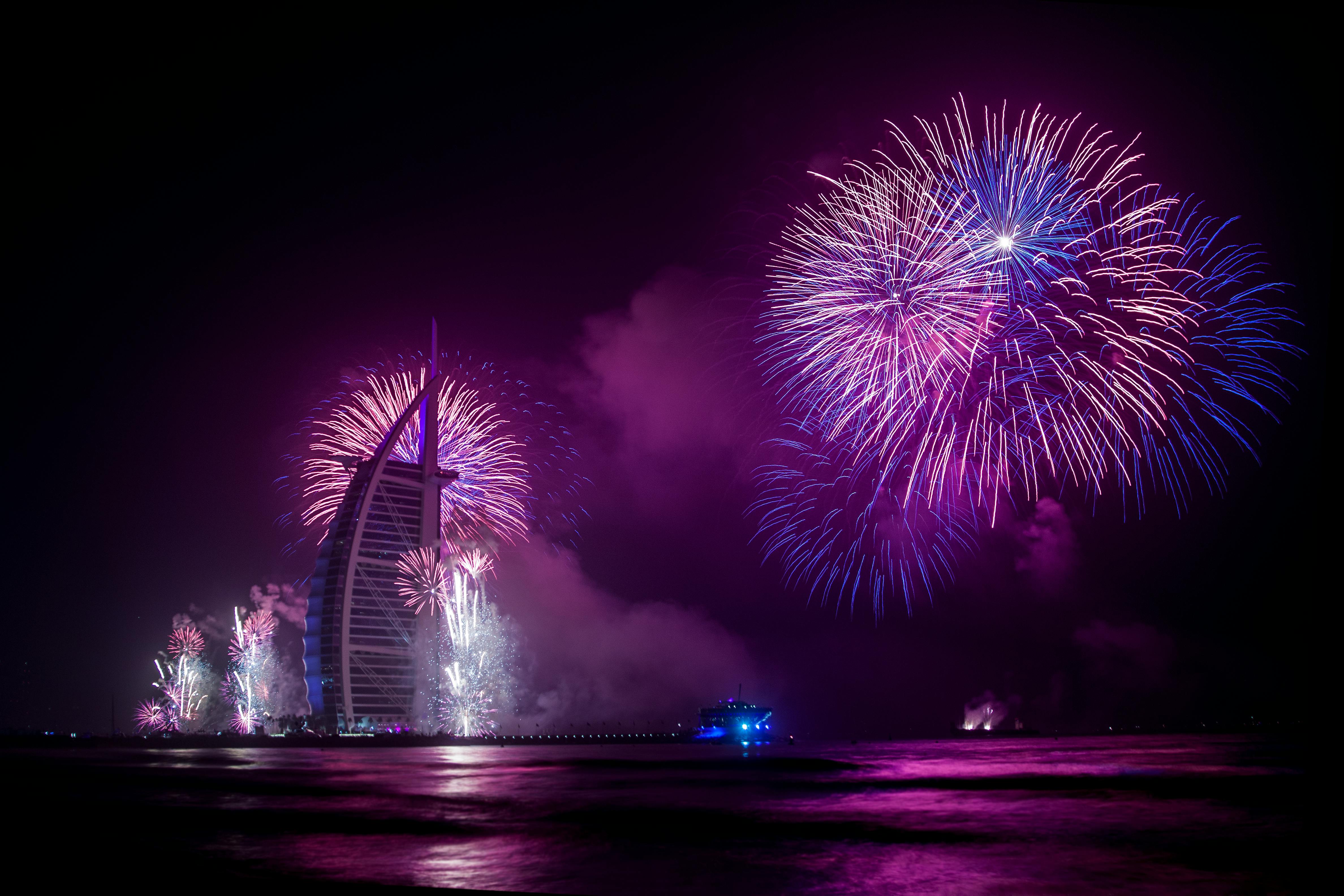
It's 11:59PM on December 31st, in a few seconds, the world will witness the biggest New Year's celebration yet. Dubai will erupt into a spectacle of light, sound, and color. Thousands of explosives will explode across forty-eight different locations, lighting up the emirate's sky. But have you ever wondered what lies behind such shows? What made those magical moments possible?
Behind those breath-taking bursts of color lies one of the most complex supply chain operations - a logistical ballet of explosives, international regulations, precision timing, and split-second coordination across an entire city.
This is the journey behind Dubai's firework show - the invisible supplychain behind the spectacle.
Let's talk scale for a moment. According to Gulf News coverage of the 2025 event, Ras Al-Khaimah's single new year event took over fifteen individual fireworks, five thousand hours of preparation, and one hundred and thirty sea pontoons. Not to mention the months of operations and advance preparation.
That was only one show, now take that complexity and multiply it by forty-eight; that's what Dubai has pulled off in the 2026 New Year Celebration.
According to Time Out Dubai, fireworks will light up forty locations from Burj Khalifa to Dubai Frame to Expo City Dubai and many other locations. Seven different displays are timed to celebrate midnight at Global Village in seven different time-zones. Meaning that visitors will get to experience the New Year in multiple times throughout the night - from Australia's midnight to California's hours later.
Each show needs its own setup, installation teams, permits, approvals, and continouos safety monitioring from evening through the next morning. One single error and it all falls apart.
No Pressure!
Here is where it gets interesting. Those beautiful fireworks? According the UN classification, they are 1.4G explosives - most of the fireworks used in Dubai's displays are even considered 1.3G (substances with fire hazards and blast potential.
According to the U.S). Pipeline and Hazardous Materials Safety Administration, every firework type must undergo thermal stability testing simulating worst-case transport conditions to ensure that they won't spontaneously combust during storage and shipping.
Each succesfully tested firework design recieves a ten-digit EX number that serves as a passport proving it's approved for transport.
Safety Data Sheets (SDS) must detail every chemical compund used.
Why does an SDS need to list every chemical? Because different chemicals react differently. Some fireworks contain magnesium that burns underwater, so water won't put it out. Others contain perchlorate compounds that are highly reactive with organic materials. Emergency responders need to know exactly what they're dealing with if something goes wrong.
For freight forwarders, this changes everything. You're not just moving boxes, you're literally playing with fire.
One wrong form? your shipment sits at customs. One handling error? well.... let's just say the consequences would be more than just missing a deadline.
The American Pyrotechnics Association reports that over ninety percent of fireworks are manufactured in China, creating a massive global supply chain that peaks before major celebrations.
Pyrotechnic specialists in Chinese factories start hand-crafting each shell months in advance - engineering specific colors, patterns, and effects. These are not mere firecrackers, they are instruments precisely designed to explode at specific altitudes with choreographed timing.
Once manufactured, the real adventure begins.
Phase 1: The Packaging Nightmare
Not only do the fireworks undergo heavy testing and certifications, but the packaging does too. The International Air Transport Association (IATA) and International Maritime Dangerous Goods (IMDG) regulations require special containers to prevent ignition, protect against impact, and display clear hazard labels.
Get any of this wrong, and carriers won't even come near your shipment.
Phase 2: Finding a Ship That Will Take You
Due to the volume and associated costs, most fireworks are shipped by sea. But (un)surprisingly enough, vessels are usually reluctant about having tons of explosives aboard. As mentioned in DSV's dangerous goods shipping guidelines, ships carrying fireworks must store them in designated hazmat areas separate from other cargo - with controlled access and environmental monitoring.
According to Ocean Transport, some ports have strict limits on explosives aboard vessel. Rotterdam can fine you up to forty-five thousand euros for violations.
Route planning suddenly become a strategic game of regulations, capacity, and risk management.
Phase 3: Documentation Olympics
In order to certify compliance with international regulations, a Shipper's Declaration of Dangerous Goods must be presented with the proper shipping names, UN identification numbers, net explosives quantities, and 24/7 emergency contacts.
In the October 2025 ADR fireworks guidance by Hazchem Safety, documentation errors are listed among the most common causes of shipping delays for pyrotechnic materials.
One missing signature? One incorrect code? Your container sits at port unmoved while the clock ticks toward December 31st.
Your shipment has finally arrived at Jebel Ali Port. Congratulations! Now comes the fun part: convincing UAE Customs to let Tons of Explosives into the country. Easier said than done!
Dubai's licensing authority for commercial firworks - The Security Industry Regulatory Authority (SIRA) - doesn't mess around. According IndexBox's analysis of Dubai's NYE security plan in 2024, SIRA requires special licenses before fireworks can even come near the UAE territory
Freight forwarders must provide:
- Advance notice to customs concerning explosive cargo quantities
- Special import permits from SIRA to prove authorization
- Detailed manifests that specificy each firework type and their storage requirements
- Proof of end-use showing exactly where they'll be deployed
- Insurance documentation covering high-value explosive cargo
Miss one document? Your shipment is held. Miss a deadline? Forty-eight venues won't get their fireworks. Miss midnight? Billions of viewers will watch....nothing.
Could the stakes be any higher?
Manufacturing, shipping, and clearing customs was one thing. Getting explosives safely to forty-eight different locations across Dubai is a challenge on a new level.
According to USA Truckload Shipping's December 2024 fireworks transport guide, vehicles carrying pyrotechnics must display "EXPLOSIVES" placards on all sides, be driven by hazmat-certified drivers, follow designated routes avoiding populated areas, and carry fire suppression equipment.
Sounds simple.
Now imagine coordinating this across Dubai's geography:
- Burj Khalifa, located in Downtown Dubai - a dense urban environment with heavy traffic and millions of residents nearby
- Bab Al-Shams Desert resort requiring transport across desert highways
- The Beach at JBR with waterfront access challenges.
- Atlantis The Palm with its limited entry points
Each venue has different loading requirements, security protocols, and staging areas.
Each delivery must be scheduled to avoid disrupting normal operations while ensuring that installation teams have enough time for setup and testing.
When it comes to transporting explosives, you can't just show up when it's convenient.
Now here's where logistics becomes pure art.
Time Out Dubai's December 26th event guide details the forty-eight locations: iconic landmarks like Burj Khalifa and Dubai Frame, entertainment hubs like Global Village and Dubai Parks, luxury resorts like Atlantis The Palm and One&Only Royal Mirage, beach venues like La Mer and Al Seef, and golf clubs throughout the emirate.
Each location requires:
- Its own freight delivery with separate customs documentation
- Installation teams that strictly involve licensed pyrotechnicians only
- Constant Safety inspections by Dubai Civil Defence
- Final approval from SIRA
- Backup plans - in case anything goes wrong
According to IndexBox's security analysis, Dubai Police will deploy 8,530 officers, Dubai Civil Defence will inspect 257 critical facilities and deploy over one thousand firefighters, and Dubai Health will establish field hospitals with 1,800 staff on standby.
This massive safety infrastructure exists because of the inherent risks - risks that have begun the moment explosives left the factory.
SIRA doesn't just license firework displays - they also control every aspect of safety. According to Dubai.News, launch areas have controlled perimeters, restricted access zones, and mandatory safety distances specified for spectators.
But safety has started way before the launch. DHL's international dangerous goods guide showcases that improper storage of firewokrs has led to catastrophic accidents in multiple countries, leading to high mortality rates and fatal injuries. Hence, storage facilities must be ceritfied for explosive materials with temperature control, spark-proof lighting, restricted access, and fire suppresion systems.
Special authorization is required for transport vehicles with proper securing mechanisms and emergency response capability.
Handling personnel must be adequately trained and specialized in explosive materials safety.
Installation sites undergo constant safety inspections - even after launch - covering electrical grounding, clearnace zones, and emergency evacuation plans before a single firework can even be placed.
For freight forwarders, this extends liabilities far beyond delivery. Any Safety incident during transport could be catastrophic, making regulatory compliance more than just a legal requirement, but also morally imperative - literally saving lives.
Shipping hazardous materials is obviously not cheap. Cargo Handbook's firework transport guidelines has made this clear: specialized containers, authorized carriers, premium insurance, hazmat documentation fees, and compliance overhead costs all stack up real quick.
For a single firework shipment, you're paying for:
- Manufacturing by specialized pyrotechnicians
- Hazmat packaging that meets international standards
- Sea freight on authorized vessel providing explosion-safe storage
- Premium marine insurance rates (the higher the risk - the higher the value)
- Port fees and hazmat handling charges at point of origin and destination
- Customs brokerage by dangerous goods specialists
- Hazmat-certified road transport
- Storage at ceritfied facilities
- Installation by licensed teams
Now take that and multiply it by forty-eight shows.
Yet for Dubai, which attracts billions of viewers globally for its celebrations, this investment pays off in tourism, international prestige, and brand value.
The city didn't just host fireworks - it has literally marketed itself to over half the planet.
Let's go back in time. It's 11:59PM on December 31st, Dubai is counting down to 2026. In a few seconds, people will be watching a beautiful spectatle crafted by the intricate supply chain network hidden behind the scenes.
People watch the golden cascades over Burj Khalifa, the synchronized displays at Atlantis the Palm, and Global Village's marvel of seven shows across different time zones.
But for those of us in freight forwarding, we look deeper. We see the months of advance preparation. We see the regulatory compliance that kept shipments moving smoothly. We see the careful handling of dangerous materials across thousands of kilometers. We see the coordination across forty-eight locations and multiple countries. We see the absolute commitment to safety and precision under immense pressure.
We see the hidden heroes, from the pyrotechnicians to the trained workers and drivers to the licensed installation teams.
We see the journey behind the event.
Dubai's New Year's Eve firworks aren't just a celebration - they're proof that complex logistics, when executed flawlessly, can create moments of pure magic.
They remind us the behind every spectacular moment, there's a myriad of logistical operations that made it happen
Remember the freight forwarders, customs brokers, and logistics professionals whose invisible work made those explosions of color possible.
Always remember the real magic of logistics.
Happy New Year!
About SpeedGate: At SpeedGate, we understand that every shipment tells a story. While we may not coordinate forty-eight simultaneous firework shows, we bring the same commitment, the same precision, the same safety, and the same reliability to every client we serve.
Complex freight? Tight deadlines? Challenging regulations? That's where we thrive.
Have a logistics challenge that needs expert handling? Contact our team now to discuss how we can support your business
Sources and References
- Time Out Dubai, "Your guide to 48 fireworks shows in Dubai this New Year's Eve 2025/2026," December 26, 2024
- Emaar, "New Year's Eve 2025 | Burj Khalifa Fireworks & Celebrations in Dubai," December 2024
- IndexBox, "Dubai 2025 NYE Guide: Full Security, Transport & Event Plan," December 26, 2024
- Dubai.News, "New Year Fireworks Takeover Dubai Sky 2026," December 25, 2024
- The National (UAE), "New Year 2026 fireworks in the UAE: Where to watch the biggest displays," December 3, 2024
- Gulf News, "RAK New Year's Eve 2025: Everything you need to know," December 26, 2024
- U.S. Pipeline and Hazardous Materials Safety Administration, "Safety Guidance for Shipping Consumer Fireworks"
- USA Truckload Shipping, "Guide to Shipping Fireworks in the U.S.," December 2024
- Ascent Logistics, "How to Transport HazMat Fireworks Within the United States," June 2024
- DSV, "Class 1 Explosives - Shipping dangerous goods"
- Ocean Transport, "Lighting Up the Sky: The Complex Art of Shipping Fireworks from China to the U.S."
- Cargo Handbook, "Fireworks - Transport Guidelines"
- DHL, "A guide to shipping dangerous goods internationally"
- Hazchem Safety, "Carriage Of Fireworks Under ADR," October 2025
- American Pyrotechnics Association, industry statistics and safety guidelines

Dubai New Year's Eve 2026: The Explosive Logistics Network That Made 48 Shows Possible
Category
Publish Date
Read Time
The Journey Behind the Event
2026-01-01
15 minutes
It's 11:59PM on December 31st, in a few seconds, the world will witness the biggest New Year's celebration yet. Dubai will erupt into a spectacle of light, sound, and color. Thousands of explosives will explode across forty-eight different locations, lighting up the emirate's sky. But have you ever wondered what lies behind such shows? What made those magical moments possible?
Behind those breath-taking bursts of color lies one of the most complex supply chain operations - a logistical ballet of explosives, international regulations, precision timing, and split-second coordination across an entire city.
This is the journey behind Dubai's firework show - the invisible supplychain behind the spectacle.
Let's talk scale for a moment. According to Gulf News coverage of the 2025 event, Ras Al-Khaimah's single new year event took over fifteen individual fireworks, five thousand hours of preparation, and one hundred and thirty sea pontoons. Not to mention the months of operations and advance preparation.
That was only one show, now take that complexity and multiply it by forty-eight; that's what Dubai has pulled off in the 2026 New Year Celebration.
According to Time Out Dubai, fireworks will light up forty locations from Burj Khalifa to Dubai Frame to Expo City Dubai and many other locations. Seven different displays are timed to celebrate midnight at Global Village in seven different time-zones. Meaning that visitors will get to experience the New Year in multiple times throughout the night - from Australia's midnight to California's hours later.
Each show needs its own setup, installation teams, permits, approvals, and continouos safety monitioring from evening through the next morning. One single error and it all falls apart.
No Pressure!
Here is where it gets interesting. Those beautiful fireworks? According the UN classification, they are 1.4G explosives - most of the fireworks used in Dubai's displays are even considered 1.3G (substances with fire hazards and blast potential.
According to the U.S). Pipeline and Hazardous Materials Safety Administration, every firework type must undergo thermal stability testing simulating worst-case transport conditions to ensure that they won't spontaneously combust during storage and shipping.
Each succesfully tested firework design recieves a ten-digit EX number that serves as a passport proving it's approved for transport.
Safety Data Sheets (SDS) must detail every chemical compund used.
Why does an SDS need to list every chemical? Because different chemicals react differently. Some fireworks contain magnesium that burns underwater, so water won't put it out. Others contain perchlorate compounds that are highly reactive with organic materials. Emergency responders need to know exactly what they're dealing with if something goes wrong.
For freight forwarders, this changes everything. You're not just moving boxes, you're literally playing with fire.
One wrong form? your shipment sits at customs. One handling error? well.... let's just say the consequences would be more than just missing a deadline.
The American Pyrotechnics Association reports that over ninety percent of fireworks are manufactured in China, creating a massive global supply chain that peaks before major celebrations.
Pyrotechnic specialists in Chinese factories start hand-crafting each shell months in advance - engineering specific colors, patterns, and effects. These are not mere firecrackers, they are instruments precisely designed to explode at specific altitudes with choreographed timing.
Once manufactured, the real adventure begins.
Phase 1: The Packaging Nightmare
Not only do the fireworks undergo heavy testing and certifications, but the packaging does too. The International Air Transport Association (IATA) and International Maritime Dangerous Goods (IMDG) regulations require special containers to prevent ignition, protect against impact, and display clear hazard labels.
Get any of this wrong, and carriers won't even come near your shipment.
Phase 2: Finding a Ship That Will Take You
Due to the volume and associated costs, most fireworks are shipped by sea. But (un)surprisingly enough, vessels are usually reluctant about having tons of explosives aboard. As mentioned in DSV's dangerous goods shipping guidelines, ships carrying fireworks must store them in designated hazmat areas separate from other cargo - with controlled access and environmental monitoring.
According to Ocean Transport, some ports have strict limits on explosives aboard vessel. Rotterdam can fine you up to forty-five thousand euros for violations.
Route planning suddenly become a strategic game of regulations, capacity, and risk management.
Phase 3: Documentation Olympics
In order to certify compliance with international regulations, a Shipper's Declaration of Dangerous Goods must be presented with the proper shipping names, UN identification numbers, net explosives quantities, and 24/7 emergency contacts.
In the October 2025 ADR fireworks guidance by Hazchem Safety, documentation errors are listed among the most common causes of shipping delays for pyrotechnic materials.
One missing signature? One incorrect code? Your container sits at port unmoved while the clock ticks toward December 31st.
Your shipment has finally arrived at Jebel Ali Port. Congratulations! Now comes the fun part: convincing UAE Customs to let Tons of Explosives into the country. Easier said than done!
Dubai's licensing authority for commercial firworks - The Security Industry Regulatory Authority (SIRA) - doesn't mess around. According IndexBox's analysis of Dubai's NYE security plan in 2024, SIRA requires special licenses before fireworks can even come near the UAE territory
Freight forwarders must provide:
- Advance notice to customs concerning explosive cargo quantities
- Special import permits from SIRA to prove authorization
- Detailed manifests that specificy each firework type and their storage requirements
- Proof of end-use showing exactly where they'll be deployed
- Insurance documentation covering high-value explosive cargo
Miss one document? Your shipment is held. Miss a deadline? Forty-eight venues won't get their fireworks. Miss midnight? Billions of viewers will watch....nothing.
Could the stakes be any higher?
Manufacturing, shipping, and clearing customs was one thing. Getting explosives safely to forty-eight different locations across Dubai is a challenge on a new level.
According to USA Truckload Shipping's December 2024 fireworks transport guide, vehicles carrying pyrotechnics must display "EXPLOSIVES" placards on all sides, be driven by hazmat-certified drivers, follow designated routes avoiding populated areas, and carry fire suppression equipment.
Sounds simple.
Now imagine coordinating this across Dubai's geography:
- Burj Khalifa, located in Downtown Dubai - a dense urban environment with heavy traffic and millions of residents nearby
- Bab Al-Shams Desert resort requiring transport across desert highways
- The Beach at JBR with waterfront access challenges.
- Atlantis The Palm with its limited entry points
Each venue has different loading requirements, security protocols, and staging areas.
Each delivery must be scheduled to avoid disrupting normal operations while ensuring that installation teams have enough time for setup and testing.
When it comes to transporting explosives, you can't just show up when it's convenient.
Now here's where logistics becomes pure art.
Time Out Dubai's December 26th event guide details the forty-eight locations: iconic landmarks like Burj Khalifa and Dubai Frame, entertainment hubs like Global Village and Dubai Parks, luxury resorts like Atlantis The Palm and One&Only Royal Mirage, beach venues like La Mer and Al Seef, and golf clubs throughout the emirate.
Each location requires:
- Its own freight delivery with separate customs documentation
- Installation teams that strictly involve licensed pyrotechnicians only
- Constant Safety inspections by Dubai Civil Defence
- Final approval from SIRA
- Backup plans - in case anything goes wrong
According to IndexBox's security analysis, Dubai Police will deploy 8,530 officers, Dubai Civil Defence will inspect 257 critical facilities and deploy over one thousand firefighters, and Dubai Health will establish field hospitals with 1,800 staff on standby.
This massive safety infrastructure exists because of the inherent risks - risks that have begun the moment explosives left the factory.
SIRA doesn't just license firework displays - they also control every aspect of safety. According to Dubai.News, launch areas have controlled perimeters, restricted access zones, and mandatory safety distances specified for spectators.
But safety has started way before the launch. DHL's international dangerous goods guide showcases that improper storage of firewokrs has led to catastrophic accidents in multiple countries, leading to high mortality rates and fatal injuries. Hence, storage facilities must be ceritfied for explosive materials with temperature control, spark-proof lighting, restricted access, and fire suppresion systems.
Special authorization is required for transport vehicles with proper securing mechanisms and emergency response capability.
Handling personnel must be adequately trained and specialized in explosive materials safety.
Installation sites undergo constant safety inspections - even after launch - covering electrical grounding, clearnace zones, and emergency evacuation plans before a single firework can even be placed.
For freight forwarders, this extends liabilities far beyond delivery. Any Safety incident during transport could be catastrophic, making regulatory compliance more than just a legal requirement, but also morally imperative - literally saving lives.
Shipping hazardous materials is obviously not cheap. Cargo Handbook's firework transport guidelines has made this clear: specialized containers, authorized carriers, premium insurance, hazmat documentation fees, and compliance overhead costs all stack up real quick.
For a single firework shipment, you're paying for:
- Manufacturing by specialized pyrotechnicians
- Hazmat packaging that meets international standards
- Sea freight on authorized vessel providing explosion-safe storage
- Premium marine insurance rates (the higher the risk - the higher the value)
- Port fees and hazmat handling charges at point of origin and destination
- Customs brokerage by dangerous goods specialists
- Hazmat-certified road transport
- Storage at ceritfied facilities
- Installation by licensed teams
Now take that and multiply it by forty-eight shows.
Yet for Dubai, which attracts billions of viewers globally for its celebrations, this investment pays off in tourism, international prestige, and brand value.
The city didn't just host fireworks - it has literally marketed itself to over half the planet.
Let's go back in time. It's 11:59PM on December 31st, Dubai is counting down to 2026. In a few seconds, people will be watching a beautiful spectatle crafted by the intricate supply chain network hidden behind the scenes.
People watch the golden cascades over Burj Khalifa, the synchronized displays at Atlantis the Palm, and Global Village's marvel of seven shows across different time zones.
But for those of us in freight forwarding, we look deeper. We see the months of advance preparation. We see the regulatory compliance that kept shipments moving smoothly. We see the careful handling of dangerous materials across thousands of kilometers. We see the coordination across forty-eight locations and multiple countries. We see the absolute commitment to safety and precision under immense pressure.
We see the hidden heroes, from the pyrotechnicians to the trained workers and drivers to the licensed installation teams.
We see the journey behind the event.
Dubai's New Year's Eve firworks aren't just a celebration - they're proof that complex logistics, when executed flawlessly, can create moments of pure magic.
They remind us the behind every spectacular moment, there's a myriad of logistical operations that made it happen
Remember the freight forwarders, customs brokers, and logistics professionals whose invisible work made those explosions of color possible.
Always remember the real magic of logistics.
Happy New Year!
About SpeedGate: At SpeedGate, we understand that every shipment tells a story. While we may not coordinate forty-eight simultaneous firework shows, we bring the same commitment, the same precision, the same safety, and the same reliability to every client we serve.
Complex freight? Tight deadlines? Challenging regulations? That's where we thrive.
Have a logistics challenge that needs expert handling? Contact our team now to discuss how we can support your business
Sources and References
- Time Out Dubai, "Your guide to 48 fireworks shows in Dubai this New Year's Eve 2025/2026," December 26, 2024
- Emaar, "New Year's Eve 2025 | Burj Khalifa Fireworks & Celebrations in Dubai," December 2024
- IndexBox, "Dubai 2025 NYE Guide: Full Security, Transport & Event Plan," December 26, 2024
- Dubai.News, "New Year Fireworks Takeover Dubai Sky 2026," December 25, 2024
- The National (UAE), "New Year 2026 fireworks in the UAE: Where to watch the biggest displays," December 3, 2024
- Gulf News, "RAK New Year's Eve 2025: Everything you need to know," December 26, 2024
- U.S. Pipeline and Hazardous Materials Safety Administration, "Safety Guidance for Shipping Consumer Fireworks"
- USA Truckload Shipping, "Guide to Shipping Fireworks in the U.S.," December 2024
- Ascent Logistics, "How to Transport HazMat Fireworks Within the United States," June 2024
- DSV, "Class 1 Explosives - Shipping dangerous goods"
- Ocean Transport, "Lighting Up the Sky: The Complex Art of Shipping Fireworks from China to the U.S."
- Cargo Handbook, "Fireworks - Transport Guidelines"
- DHL, "A guide to shipping dangerous goods internationally"
- Hazchem Safety, "Carriage Of Fireworks Under ADR," October 2025
- American Pyrotechnics Association, industry statistics and safety guidelines
Dubai New Year's Eve 2026: The Explosive Logistics Network That Made 48 Shows Possible
Category
Publish Date
Read Time
The Journey Behind the Event
2026-01-01
15 minutes
It's 11:59PM on December 31st, in a few seconds, the world will witness the biggest New Year's celebration yet. Dubai will erupt into a spectacle of light, sound, and color. Thousands of explosives will explode across forty-eight different locations, lighting up the emirate's sky. But have you ever wondered what lies behind such shows? What made those magical moments possible?
Behind those breath-taking bursts of color lies one of the most complex supply chain operations - a logistical ballet of explosives, international regulations, precision timing, and split-second coordination across an entire city.
This is the journey behind Dubai's firework show - the invisible supplychain behind the spectacle.
Let's talk scale for a moment. According to Gulf News coverage of the 2025 event, Ras Al-Khaimah's single new year event took over fifteen individual fireworks, five thousand hours of preparation, and one hundred and thirty sea pontoons. Not to mention the months of operations and advance preparation.
That was only one show, now take that complexity and multiply it by forty-eight; that's what Dubai has pulled off in the 2026 New Year Celebration.
According to Time Out Dubai, fireworks will light up forty locations from Burj Khalifa to Dubai Frame to Expo City Dubai and many other locations. Seven different displays are timed to celebrate midnight at Global Village in seven different time-zones. Meaning that visitors will get to experience the New Year in multiple times throughout the night - from Australia's midnight to California's hours later.
Each show needs its own setup, installation teams, permits, approvals, and continouos safety monitioring from evening through the next morning. One single error and it all falls apart.
No Pressure!
Here is where it gets interesting. Those beautiful fireworks? According the UN classification, they are 1.4G explosives - most of the fireworks used in Dubai's displays are even considered 1.3G (substances with fire hazards and blast potential.
According to the U.S). Pipeline and Hazardous Materials Safety Administration, every firework type must undergo thermal stability testing simulating worst-case transport conditions to ensure that they won't spontaneously combust during storage and shipping.
Each succesfully tested firework design recieves a ten-digit EX number that serves as a passport proving it's approved for transport.
Safety Data Sheets (SDS) must detail every chemical compund used.
Why does an SDS need to list every chemical? Because different chemicals react differently. Some fireworks contain magnesium that burns underwater, so water won't put it out. Others contain perchlorate compounds that are highly reactive with organic materials. Emergency responders need to know exactly what they're dealing with if something goes wrong.
For freight forwarders, this changes everything. You're not just moving boxes, you're literally playing with fire.
One wrong form? your shipment sits at customs. One handling error? well.... let's just say the consequences would be more than just missing a deadline.
The American Pyrotechnics Association reports that over ninety percent of fireworks are manufactured in China, creating a massive global supply chain that peaks before major celebrations.
Pyrotechnic specialists in Chinese factories start hand-crafting each shell months in advance - engineering specific colors, patterns, and effects. These are not mere firecrackers, they are instruments precisely designed to explode at specific altitudes with choreographed timing.
Once manufactured, the real adventure begins.
Phase 1: The Packaging Nightmare
Not only do the fireworks undergo heavy testing and certifications, but the packaging does too. The International Air Transport Association (IATA) and International Maritime Dangerous Goods (IMDG) regulations require special containers to prevent ignition, protect against impact, and display clear hazard labels.
Get any of this wrong, and carriers won't even come near your shipment.
Phase 2: Finding a Ship That Will Take You
Due to the volume and associated costs, most fireworks are shipped by sea. But (un)surprisingly enough, vessels are usually reluctant about having tons of explosives aboard. As mentioned in DSV's dangerous goods shipping guidelines, ships carrying fireworks must store them in designated hazmat areas separate from other cargo - with controlled access and environmental monitoring.
According to Ocean Transport, some ports have strict limits on explosives aboard vessel. Rotterdam can fine you up to forty-five thousand euros for violations.
Route planning suddenly become a strategic game of regulations, capacity, and risk management.
Phase 3: Documentation Olympics
In order to certify compliance with international regulations, a Shipper's Declaration of Dangerous Goods must be presented with the proper shipping names, UN identification numbers, net explosives quantities, and 24/7 emergency contacts.
In the October 2025 ADR fireworks guidance by Hazchem Safety, documentation errors are listed among the most common causes of shipping delays for pyrotechnic materials.
One missing signature? One incorrect code? Your container sits at port unmoved while the clock ticks toward December 31st.
Your shipment has finally arrived at Jebel Ali Port. Congratulations! Now comes the fun part: convincing UAE Customs to let Tons of Explosives into the country. Easier said than done!
Dubai's licensing authority for commercial firworks - The Security Industry Regulatory Authority (SIRA) - doesn't mess around. According IndexBox's analysis of Dubai's NYE security plan in 2024, SIRA requires special licenses before fireworks can even come near the UAE territory
Freight forwarders must provide:
- Advance notice to customs concerning explosive cargo quantities
- Special import permits from SIRA to prove authorization
- Detailed manifests that specificy each firework type and their storage requirements
- Proof of end-use showing exactly where they'll be deployed
- Insurance documentation covering high-value explosive cargo
Miss one document? Your shipment is held. Miss a deadline? Forty-eight venues won't get their fireworks. Miss midnight? Billions of viewers will watch....nothing.
Could the stakes be any higher?
Manufacturing, shipping, and clearing customs was one thing. Getting explosives safely to forty-eight different locations across Dubai is a challenge on a new level.
According to USA Truckload Shipping's December 2024 fireworks transport guide, vehicles carrying pyrotechnics must display "EXPLOSIVES" placards on all sides, be driven by hazmat-certified drivers, follow designated routes avoiding populated areas, and carry fire suppression equipment.
Sounds simple.
Now imagine coordinating this across Dubai's geography:
- Burj Khalifa, located in Downtown Dubai - a dense urban environment with heavy traffic and millions of residents nearby
- Bab Al-Shams Desert resort requiring transport across desert highways
- The Beach at JBR with waterfront access challenges.
- Atlantis The Palm with its limited entry points
Each venue has different loading requirements, security protocols, and staging areas.
Each delivery must be scheduled to avoid disrupting normal operations while ensuring that installation teams have enough time for setup and testing.
When it comes to transporting explosives, you can't just show up when it's convenient.
Now here's where logistics becomes pure art.
Time Out Dubai's December 26th event guide details the forty-eight locations: iconic landmarks like Burj Khalifa and Dubai Frame, entertainment hubs like Global Village and Dubai Parks, luxury resorts like Atlantis The Palm and One&Only Royal Mirage, beach venues like La Mer and Al Seef, and golf clubs throughout the emirate.
Each location requires:
- Its own freight delivery with separate customs documentation
- Installation teams that strictly involve licensed pyrotechnicians only
- Constant Safety inspections by Dubai Civil Defence
- Final approval from SIRA
- Backup plans - in case anything goes wrong
According to IndexBox's security analysis, Dubai Police will deploy 8,530 officers, Dubai Civil Defence will inspect 257 critical facilities and deploy over one thousand firefighters, and Dubai Health will establish field hospitals with 1,800 staff on standby.
This massive safety infrastructure exists because of the inherent risks - risks that have begun the moment explosives left the factory.
SIRA doesn't just license firework displays - they also control every aspect of safety. According to Dubai.News, launch areas have controlled perimeters, restricted access zones, and mandatory safety distances specified for spectators.
But safety has started way before the launch. DHL's international dangerous goods guide showcases that improper storage of firewokrs has led to catastrophic accidents in multiple countries, leading to high mortality rates and fatal injuries. Hence, storage facilities must be ceritfied for explosive materials with temperature control, spark-proof lighting, restricted access, and fire suppresion systems.
Special authorization is required for transport vehicles with proper securing mechanisms and emergency response capability.
Handling personnel must be adequately trained and specialized in explosive materials safety.
Installation sites undergo constant safety inspections - even after launch - covering electrical grounding, clearnace zones, and emergency evacuation plans before a single firework can even be placed.
For freight forwarders, this extends liabilities far beyond delivery. Any Safety incident during transport could be catastrophic, making regulatory compliance more than just a legal requirement, but also morally imperative - literally saving lives.
Shipping hazardous materials is obviously not cheap. Cargo Handbook's firework transport guidelines has made this clear: specialized containers, authorized carriers, premium insurance, hazmat documentation fees, and compliance overhead costs all stack up real quick.
For a single firework shipment, you're paying for:
- Manufacturing by specialized pyrotechnicians
- Hazmat packaging that meets international standards
- Sea freight on authorized vessel providing explosion-safe storage
- Premium marine insurance rates (the higher the risk - the higher the value)
- Port fees and hazmat handling charges at point of origin and destination
- Customs brokerage by dangerous goods specialists
- Hazmat-certified road transport
- Storage at ceritfied facilities
- Installation by licensed teams
Now take that and multiply it by forty-eight shows.
Yet for Dubai, which attracts billions of viewers globally for its celebrations, this investment pays off in tourism, international prestige, and brand value.
The city didn't just host fireworks - it has literally marketed itself to over half the planet.
Let's go back in time. It's 11:59PM on December 31st, Dubai is counting down to 2026. In a few seconds, people will be watching a beautiful spectatle crafted by the intricate supply chain network hidden behind the scenes.
People watch the golden cascades over Burj Khalifa, the synchronized displays at Atlantis the Palm, and Global Village's marvel of seven shows across different time zones.
But for those of us in freight forwarding, we look deeper. We see the months of advance preparation. We see the regulatory compliance that kept shipments moving smoothly. We see the careful handling of dangerous materials across thousands of kilometers. We see the coordination across forty-eight locations and multiple countries. We see the absolute commitment to safety and precision under immense pressure.
We see the hidden heroes, from the pyrotechnicians to the trained workers and drivers to the licensed installation teams.
We see the journey behind the event.
Dubai's New Year's Eve firworks aren't just a celebration - they're proof that complex logistics, when executed flawlessly, can create moments of pure magic.
They remind us the behind every spectacular moment, there's a myriad of logistical operations that made it happen
Remember the freight forwarders, customs brokers, and logistics professionals whose invisible work made those explosions of color possible.
Always remember the real magic of logistics.
Happy New Year!
About SpeedGate: At SpeedGate, we understand that every shipment tells a story. While we may not coordinate forty-eight simultaneous firework shows, we bring the same commitment, the same precision, the same safety, and the same reliability to every client we serve.
Complex freight? Tight deadlines? Challenging regulations? That's where we thrive.
Have a logistics challenge that needs expert handling? Contact our team now to discuss how we can support your business
Sources and References
- Time Out Dubai, "Your guide to 48 fireworks shows in Dubai this New Year's Eve 2025/2026," December 26, 2024
- Emaar, "New Year's Eve 2025 | Burj Khalifa Fireworks & Celebrations in Dubai," December 2024
- IndexBox, "Dubai 2025 NYE Guide: Full Security, Transport & Event Plan," December 26, 2024
- Dubai.News, "New Year Fireworks Takeover Dubai Sky 2026," December 25, 2024
- The National (UAE), "New Year 2026 fireworks in the UAE: Where to watch the biggest displays," December 3, 2024
- Gulf News, "RAK New Year's Eve 2025: Everything you need to know," December 26, 2024
- U.S. Pipeline and Hazardous Materials Safety Administration, "Safety Guidance for Shipping Consumer Fireworks"
- USA Truckload Shipping, "Guide to Shipping Fireworks in the U.S.," December 2024
- Ascent Logistics, "How to Transport HazMat Fireworks Within the United States," June 2024
- DSV, "Class 1 Explosives - Shipping dangerous goods"
- Ocean Transport, "Lighting Up the Sky: The Complex Art of Shipping Fireworks from China to the U.S."
- Cargo Handbook, "Fireworks - Transport Guidelines"
- DHL, "A guide to shipping dangerous goods internationally"
- Hazchem Safety, "Carriage Of Fireworks Under ADR," October 2025
- American Pyrotechnics Association, industry statistics and safety guidelines